The Bigger Gear Bag Is Not Always the Better One
A task-first gear bag keeps fitness equipment relevant to the session, easier to carry, and ready to use instead of buried beneath unused extras.
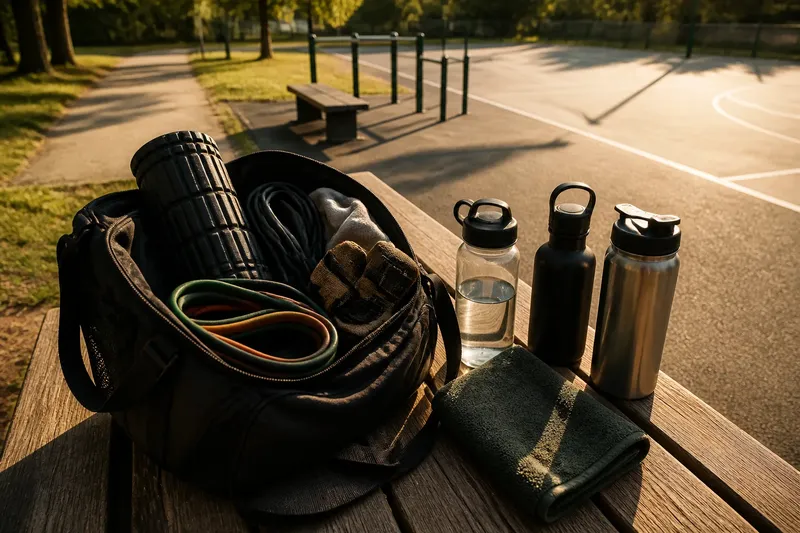
A task-first gear bag makes a workout easier to begin because every item has a job. Before packing resistance bands, a jump rope, lifting straps, a foam roller, and three kinds of bottle, name the movement the session is meant to support. The bag should serve that plan, not substitute for one.
Start with the session
Equipment earns its place by changing what you can do, how you can do it, or how comfortably you can take part. If the session is a walk in a park, a pair of shoes that suits the surface may matter more than a collection of accessories. If it is a strength session at a community gym, the available equipment may already cover the planned work.
Write the session in plain verbs: carry, push, pull, step, stretch, or throw. Then consider what the venue provides and what you need to bring. This quick inventory separates useful gear from objects that merely resemble preparation.
Say you plan to walk to a neighborhood court, practise a few body-weight movements, and walk home. If the court has a bench and open space, a small water bottle and a light layer may be relevant; a pair of heavy lifting straps is not. The observable result is a bag that leaves your hands free and still supports the actual outing.
Give each item a job
A useful packing question is not “Could this come in handy?” Almost anything could. Ask instead, “What part of this session depends on this item?” If the answer is vague, set it aside and see whether the plan changes.
- Primary tool: Does it make the planned movement possible, such as a resistance band for a pulling exercise when no suitable anchor or machine is available?
- Fit or comfort item: Does it help you take part comfortably, such as shoes with a stable feel for the surface you chose?
- Recovery or access item: Does it solve a specific transition, such as a dry shirt for travelling back to work?
- Duplicate: Is another item already doing the same job, such as two bottles or several versions of one stretch aid?
- Contingency item: Is there a realistic change in the session that makes it useful, or is it packed against a string of unlikely possibilities?
This is not a rule that every bag must be minimal. A long outing, changing weather, or a session in a facility with limited equipment can call for more. The point is to connect each addition to an actual need, rather than treating fullness as proof of readiness.
Account for the venue
The room or route is part of the equipment decision. A studio may have mats and blocks; a public track may have no place to store a bulky jacket; a busy gym may have bands but not the particular resistance or attachment your plan requires. Check what is available before carrying a duplicate.
Storage and travel matter, too. A compact item can still be inconvenient if it leaks, tangles, or needs a clean surface you will not have. A larger item may be sensible if it replaces several small pieces and has a clear role. Judge the whole trip, from leaving home to packing up, rather than the item alone.
For gear whose use depends on a product label, manufacturer instructions, or local facility rules, follow those directions. That is especially relevant for equipment that attaches to a structure or is restricted in a shared space.
Spot the hidden costs
Extra equipment can create small jobs: cleaning, drying, untangling, charging, and finding a place to store it. Those jobs are easy to ignore while packing, but they arrive after the session, when attention has moved elsewhere. An item that routinely returns unused may be taking up more than bag space.
There is also a decision cost. When several tools could fit the same purpose, you may spend the first part of a session choosing among them. For a simple plan, one familiar option can be more useful than a menu of alternatives. This is not a claim that variety is bad; it is a reminder that variety should serve the movement, not interrupt it.
Not worth the effort: packing a spare version of every accessory “just in case” when there is no plausible reason the planned session will change. If a genuine need appears, you can adjust the next outing instead of hauling a miniature equipment closet today.
Questions before packing?
How do I choose gear for a workout?
Start with the movements, setting, and duration you have planned, then identify the items needed to do them comfortably. Leave out gear that has no clear connection to those choices.
Should I bring resistance bands to the gym?
Bring them if your plan uses a band for a specific movement or if the gym’s available equipment does not suit that movement. If the session already has appropriate options, the bands may be unnecessary.
What belongs in a basic fitness bag?
There is no single set for every activity. A useful starting point is activity-appropriate clothing or footwear, a way to carry water if needed, and any item the venue does not provide for the session you chose.
How can I tell if I carry too much equipment?
Notice which items come home unused and whether packing, carrying, or unpacking them makes starting harder. Remove one nonessential item on a later outing and see whether the session still works as planned.
Keep the plan flexible
A task-first bag is a starting point, not a permanent packing formula. If you change the route, venue, or planned movements, review the gear against those changes. A brief note on your phone or a small packing card can help if you often repeat the same type of outing.
For a session with uncertain conditions, choose one plausible backup rather than packing for every possibility. A light layer may cover a weather change; a second full set of equipment may not. The right backup is the one that addresses a realistic disruption without quietly becoming another default item.
Use the same principle when buying equipment: decide what task it will support, where you will use it, and what it replaces or adds. If those answers are clear, the gear has a reason to enter your routine. If they are not, leave the purchase—and the extra weight—until the session gives you a better reason.
A smaller bag is not the goal by itself. The useful goal is a bag whose contents make the next movement easier to begin, with no essential item buried under things that never had a task.