Balance Is a Skill You Can Practise in Small Movements
Balance is a skill you can practise in small movements. Learn how tiny shifts, steady breathing, and simple household tasks build useful control.
Balance is a skill you can practise in small movements, not a fixed trait that some people simply have and others lack. Stand still in a comfortable stance and your ankles, hips, and trunk are already making small adjustments to keep your body over the support beneath it.
That support might be both feet on a kitchen floor, one foot on a curb, or a hand resting lightly on a counter. Balance changes as your position, the surface, and the task change, so practising it can be as ordinary as shifting your weight with attention.
What balance involves
Balance is the ongoing work of keeping your body controlled in relation to its base of support. Your base is the area beneath you that can help hold you up: two planted feet provide a broader base than one foot, while a hand on a sturdy counter adds another point of support.
Your body gathers information from vision, the inner ear, and sensors in muscles and joints. It uses that information to adjust posture and movement. You do not need to consciously direct each tiny correction; noticing how a movement feels is enough to make practice more purposeful.
Stillness is only one kind of balance. Walking, reaching for a cupboard, stepping around a puddle, or turning to speak to someone all ask you to manage changing positions. A steady body is not necessarily motionless; it is one that can respond to motion without losing control.
Why it varies by task
Balance can feel different from one moment to the next because the task changes the support available. Standing with feet apart on a firm floor is usually more forgiving than standing with feet close together, turning your head, or reaching to the side. Each change asks your body to make a different set of adjustments.
Attention and fatigue matter too. If you are distracted, carrying something that blocks your view, or tired after activity, a familiar movement may feel less settled. That does not mean your balance has become a permanent trait in either direction; it reflects the demands of that moment.
Small movements make these demands easier to notice. Shift your weight toward one foot and back, for example, and pay attention to how pressure travels across the soles. The aim is not to hold a dramatic pose. It is to recognize the body’s response and stay in control as the position changes.
How can small movements build balance?
What counts as balance practice?
Practice can be a deliberate, gentle shift of weight from one foot to the other, or a slow reach while your feet remain comfortably planted. Everyday movements can count too, as long as you choose a manageable task and notice how your body stays controlled.
Do I need to stand on one leg?
No. One-leg standing is only one way to challenge balance, and it may be an unsuitable starting point for some people. Begin with both feet supported and use a counter or sturdy chair if you want an extra point of support.
Should I close my eyes to make it harder?
Not as a casual first step. Vision helps you orient yourself, so removing it can make a task harder to manage; keep your eyes open and work on a clear, stable surface instead.
How often should I practise?
There is no single schedule that suits everyone. A brief, comfortable practice can fit into an ordinary routine, but stop if you feel unsteady, dizzy, or in pain, and seek advice from a qualified health professional if balance changes concern you.
Where can practice fit?
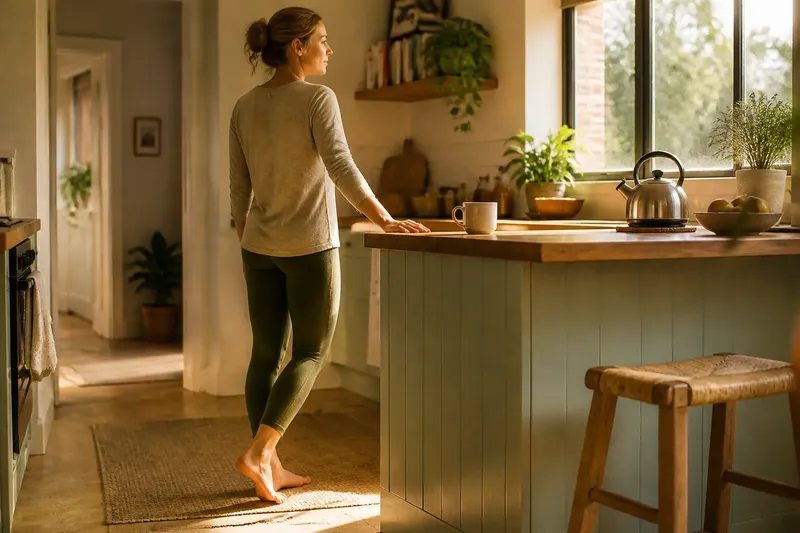
Choose moments when you are already near a safe, stable surface rather than turning a household chore into a test. At a kitchen counter, you might stand with feet comfortably apart and shift your weight gently from side to side. Keep the movement small enough that you can return to center smoothly.
Imagine you are waiting for a kettle to boil and notice that you tend to lean onto one hip. You could place both feet on the floor, rest a hand on the counter, and slowly move a little weight toward each foot. The observable result to look for is a controlled return to your usual stance, not a perfect posture or a particular duration.
Other ordinary options include shifting weight while brushing your teeth, reaching for a light object from a stable stance, or stepping over a low, visible threshold with care. These are not opportunities to add surprise or speed. Choose a clear space, leave obstacles out of the way, and make the movement suit your comfort.
There is little value in chasing wobbly poses for their own sake. Unstable furniture, slippery floors, and eyes-closed challenges add risk without making a small, controlled movement more useful.
How do you make a movement easier or harder?
Change one feature at a time. For example, start with feet apart, then bring them slightly closer only if the current stance feels controlled. Keep a hand near a counter; using it for light support is a sensible adjustment, not a failure.
You can also vary the direction of a reach or the amount of weight you shift, while keeping the surface and surroundings familiar. A smaller movement is a valid choice when you feel tired or distracted. The point is to practise a response you can manage, rather than force a position that makes you brace or grab for support.
Notice how you breathe and whether your shoulders or jaw tighten. Holding your breath or gripping hard can be a sign that the task is demanding more concentration than you want to give it. Return to a comfortable stance, then choose an easier variation if you continue.
What changes deserve attention?
Ordinary wobbling during a new movement is not the same as a sudden or persistent change in balance. If you have repeated falls, new dizziness, pain, or trouble with familiar daily movements, pause the practice and discuss the change with a qualified health professional. A clinician can help consider possible causes and appropriate next steps.
For general practice, keep the floor dry and uncluttered, use a stable support, and avoid movements that make you feel unsafe. If an existing health condition, recent injury, or mobility concern affects your choices, ask a qualified professional for guidance tailored to you.
What progress looks like
Progress may appear as a smoother return to center, less need to grip a support, or greater ease during a familiar reach. These are useful observations, not scores you need to chase. Balance is task-specific, so feeling steadier in one position does not mean every surface or movement will feel identical.
Keep the practice small enough to repeat without dread. A relaxed weight shift beside a kitchen counter can teach you to notice support, position, and control; over time, that attention can make ordinary movements feel more deliberate. Balance remains a skill you can practise in small movements, with the right challenge being the one you can manage today.