How a Mechanical Pedometer Counts Your Steps
See how a mechanical pedometer turns walking into a step count, check whether it responds consistently, and use its record without mistaking it for a fitness score.
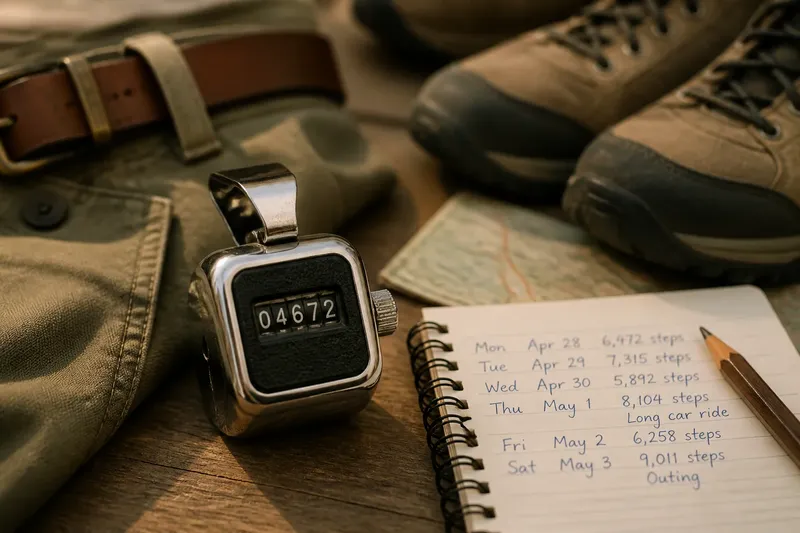
A mechanical pedometer counts steps by turning the movement of your body into the motion of a small internal mechanism. Clip one upright at your waistband and its swinging weight or lever can advance a counter as you walk—but bumps and a poor fit can affect the reading.
The counting mechanism
In a common mechanical design, walking makes a weighted arm swing. That movement advances a toothed wheel or similar counter, shifting the display by one step. Other models use a spring-loaded arm or a pendulum-like weight, but the principle is much the same: movement must cross a threshold to register.
A soft shuffle may not move the mechanism enough, while a jostle from a bag or a bumpy ride may trigger it. The device does not recognize the purpose of your movement; it responds to a pattern it was designed to detect.
Wear it as designed
Many traditional models clip upright at the waistband near the hip. A tilted counter may not swing as intended, so check the maker’s instructions for placement and any adjustment the device requires. If it has a reset button or wheel, clear the display before a walk or at a consistent point in your day.
Walk naturally on a familiar, level route. Exaggerating your stride to make the number rise changes the very movement you are trying to record.
Check its response
A short hand count can reveal whether the counter is behaving plausibly. Choose an uninterrupted walk, count each footfall, and compare your tally with the display before and after. The counts need not match exactly; look for a device that advances in step with your movement rather than staying still or racing ahead.
Say you clip on a counter before walking from your front door to a nearby corner. You count aloud and see that the display has barely moved. You check the instructions, straighten the clip at your waistband, and walk the same route again; if the counter now advances steadily, its position was a likely factor, while a display that still does not respond suggests checking the device or its adjustment instructions.
This is a basic behavior check, not a calibration procedure. Keep the route, pace, and placement familiar when comparing attempts, and do not chase an exact match.
Use a simple log
Once the counter responds consistently enough for your purpose, record its display at a chosen time in a notebook or on a paper calendar. Add a brief note when the day was unusual: a long car ride, an outing, or hours spent mostly indoors can help explain the tally later.
Check the conditions behind a number, then decide how to interpret it:
- Check whether the counter stayed upright at your waistband; if it did, treat the reading as comparable with other days worn the same way, but if it tilted, note the difference and avoid a direct comparison.
- Check whether you reset it at your usual time; if you did, use the tally as a full-day record, but if you forgot, label it partial rather than treating it as a complete day.
- Check whether a long car ride or other jostling occurred; if it did, add that context and treat possible extra counts cautiously, but if it did not, read the number without that particular caveat.
- Check whether the day included cycling, swimming, or strength work; if it did, remember that the step count leaves out much of that activity, but if it did not, the tally still represents detected steps rather than all movement.
- Check whether you compared similar kinds of days; if both were ordinary workdays, use the difference to notice a possible routine change, but if one was an outing day, compare it with a similar outing instead.
- Check whether the counter advances during an ordinary walk; if it does, keep using it consistently, but if it barely moves or advances while you stand still, review placement and the maker’s instructions before relying on the record.
What does the count mean?
Does it count every footfall?
No. A mechanical counter registers movement that triggers its mechanism, so a gentle gait may be undercounted and repeated shaking may add steps that were not part of a walk.
Can I wear it in a pocket?
Only if the maker says that placement is suitable. Many traditional models are designed to clip upright at the waistband, and a pocket may change how the mechanism swings.
Can I compare different devices?
Use caution because mechanisms and placement rules vary. One device worn consistently is more useful for noticing your own routine than comparing its display directly with someone else’s.
Does the count measure fitness?
No. It records detected steps, not effort, health, or every kind of physical activity. Use it as one observation alongside how movement fits your day and how your body feels.
Read the history narrowly
A mechanical pedometer shows how walking can be turned into a portable tally: body motion moves a part, and that part advances a display. Its value as a historical object is clear at that scale. The mechanism makes step counting tangible without requiring a claim that it transformed how people everywhere talked about movement.
Phones now use electronic sensors and software to estimate steps, while a mechanical counter responds through a moving part. In either case, a visible number is a record of detected movement, not an explanation of what caused it or a complete account of activity.
Keep the record in context
Use the count to notice patterns, not to grade yourself. A lower tally might reflect weather, work demands, errands, or a change in how you wore the device. Comparing similar days can help you see when walking fits into your routine without pretending that the display captures everything.
It is not worth restarting a walk until your hand tally and the mechanism agree exactly. If you want to encourage more walking, look for a routine that already fits—such as a familiar errand or a break-time loop—and decide whether it suits your schedule and physical needs. A mechanical pedometer is most useful when its step count prompts a sensible question, not when it becomes a verdict.